In any high-traffic logistics platform, floor joints don’t age the same way. While some remain tight, others become dangerous gaps. This isn’t random; it is often the direct result of the initial slab-on-grade concrete slab construction conditions.
Friction and Concrete Shrinkage: The Risk of Outdoor Pouring
Concrete begins to shrink during its curing phase. Ideally, this movement should be distributed evenly across every saw-cut control joint. However, a major disruptor often interferes: subgrade friction.
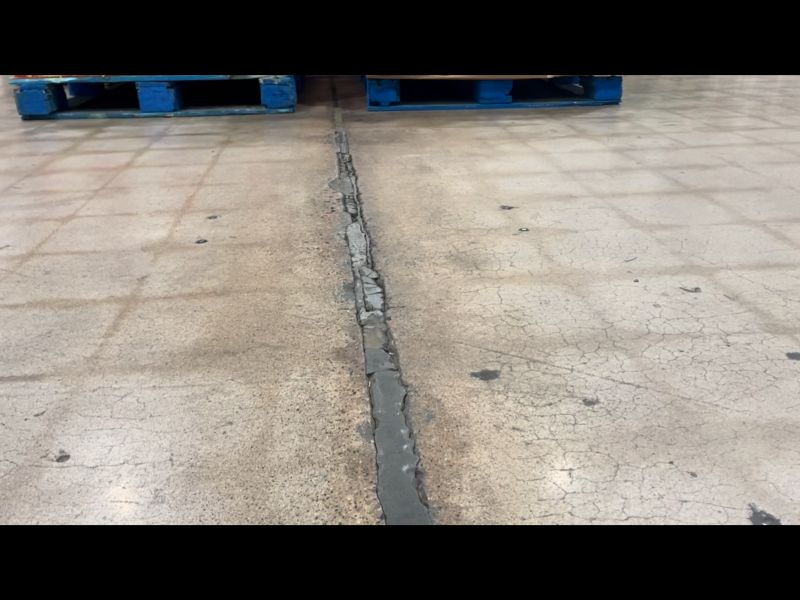
This issue is amplified when the concrete is poured before the building is enclosed. Direct exposure to sun and wind creates an unstable environment. The concrete “grabs” the subgrade unevenly. Where friction is highest, the slab stays anchored, forcing the adjacent “weaker” joint to open excessively to compensate. This gap is often mistaken for a standard expansion joint, but it is actually a structural failure.
Concrete Curling: The Number One Enemy of Forklift Wheels
Concrete curling is the leading cause of floor flatness issues. This phenomenon is accelerated during outdoor pours because surface water evaporates much faster than at the bottom of the slab
This moisture gradient causes the edges of the slab to warp upward. Whether it is a contraction joint or a construction joint, the shoulder is no longer supported. Under repeated traffic, the joint “pumps” under the load, shattering the edges and destroying your forklift wheels—a problem that standard fillers cannot fix.
Load Transfer Failure: Dowels, Steel Fibers, and Welded Wire Mesh
For a joint to survive, weight must be shared. This is the job of load transfer devices: Round Dowels, Diamond Dowels, Steel Fibers, or Welded Wire Mesh (often placed directly under saw-cut joints).
Under difficult pouring conditions, the imprecise placement of these reinforcements leaves the slab to take 100% of the impact at every pass. Without effective load transfer, the concrete structure eventually breaks down, leading to severe spalling.
The Fatal Flaw: The 90° Straight Joint Design
Even with a high-quality industrial floor treatment, a fundamental cause of failure is often ignored: the joint design itself. The traditional joint is a straight line. Every time a vehicle passes, the wheels hit the concrete edge at a 90-degree angle. This creates a brutal vertical impact. Traditional concrete repair mortars fill the shrinkage gap but do not change this destructive geometry. They endure constant hammering until they crack or delaminate. As long as the contact remains at 90°, any repair is only temporary.
The SmoothJoint™ Solution (Patent Pending): Restoring Structural Monolithism
The SmoothJoint™ system addresses the root cause through structural encapsulation and a major design breakthrough:
- The “S-Shape” Innovation: By replacing the straight joint with an S-shape, we eliminate the 90-degree wheel impact. The impact is eliminated, not just mitigated. This fixes the original design flaw while filling the shrinkage void, drastically reducing your forklift repair costs.
- Accommodating Concrete Movement: In warehouse environments, shrinkage is significantly greater than expansion. The SmoothJoint™ is specifically engineered to handle this: the lip of our composite joint is designed to stay flush and accompany the slab’s movement as the joint opens, maintaining a seamless transition.
- Targeting Stabilized Slabs: We typically work on slabs at least 2 years old, where over 90% of the shrinkage has already occurred. Our resin mortar is twice as strong as traditional concrete and fills the gap permanently.
- Restoring Integrity: Our encapsulation restores the monolithism of the structure. The two slabs are locked back together for seamless load transfer.
- Perfect Flush Finish: Both the composite material and mortar are fully grindable. We shave the surface to correct curling and guarantee a 100% flush transition.
About the Author
Christophe Mille | Founder of SmoothJoint™ | CEO of S-Line Systems LLC With 25 years of international experience in concrete structures across Europe and the USA, Christophe developed the SmoothJoint™ technology (Patent Pending) to transform high-maintenance warehouses into seamless, high-performance operations.
A degraded joint costs far more than just the price of the repair; it directly impacts your productivity and increases forklift repair expenses.
If you have a joint that opens excessively or ‘pumps’ despite multiple repair attempts, the issue is deeper than a simple crack. At SmoothJoint™, we provide a permanent structural restoration. Move from impact to fluidity: contact us today for a technical evaluation of your concrete slab.