
In a warehouse, the floor is your most heavily used tool. While the concrete slab may seem solid, expansion joints (or more accurately, shrinkage joints) are often an invisible bottleneck costing your operation time and money.
Expansion Joints: The “90-Degree Impact” Problem
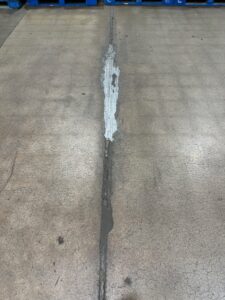
The primary cause of floor degradation isn’t just the weight of the loads, but the geometry of the expansion joints. Most joints are cut at a 90-degree angle, perfectly perpendicular to the traffic of forklifts and pallet jacks.
When a piece of handling equipment crosses this joint:
- Direct Impact: The rigid wheels literally drop into the joint gap before slamming into the opposite edge.
- The Jackhammer Effect: Every repeated pass acts like a hammer blow to the concrete edge, causing “spalling” (chipping).
- The Vicious Cycle: As the concrete crumbles, the impact becomes more violent, accelerating the destruction of both the joint and the equipment.
Why Do Traditional Resin Mortar Repairs Fail?
When faced with this problem, the common reflex is to “plug” the hole with resin or mortar. Here is why these solutions rarely last more than a few months:
- Continuous Slab Shrinkage: In controlled environments, concrete undergoes very little thermal expansion. Instead, it experiences long-term hydraulic shrinkage. The slabs on either side of the joint move away from each other. A rigid resin mortar cannot follow this movement and inevitably cracks or de-bonds.
- The “Micro-Step” Trap: In a perfect world, both slabs would be at the same level. In reality, a height difference no thicker than a credit card is enough to create a “step.” For a forklift with hard wheels, this is a major obstacle. Resin, simply poured into the gap, does not structurally correct this unevenness and eventually shatters under repeated shocks.
- The Attack Angle Remains Unchanged: Even with high-quality resin, the traffic still hits at 90 degrees. Without changing the angle of impact, you are only treating the symptom, not the physical cause of the problem.
The Solution Isn’t the Material, It’s the Geometry
Many warehouse managers believe they just need to find a “stronger” mortar or a “miracle” resin. This is a diagnostic error. To solve this problem, you don’t need to change the chemical composition of the repair, but the way the wheel load is distributed.
The goal is to eliminate the brutal impact of the tire on the concrete edge. The ideal technical solution is to replace the straight line with an “S” shaped profile.
Why an S-profile? Unlike a straight joint, a sinusoidal shape allows the wheels to always remain in contact with both slabs simultaneously. The load doesn’t “jump” from one side to the other; it is transferred progressively, eliminating shocks and vibrations.
But What If My Construction Joint Is a Straight Line?
This is where it gets complicated: if your original joint is straight, how can you integrate this geometry without heavy and costly demolition?
This is Where SmoothJoint Comes In
SmoothJoint is an innovative composite material system specifically designed to solve this dilemma. Rather than just “filling” a crack, we redefine the transition zone:
- Transfer Geometry: Thanks to its specific profile, SmoothJoint transforms your straight joint into a fluid transition zone that redistributes the load.
- High-Performance Composite Material: Unlike traditional mortars, our composite material is designed to absorb micro-shocks while remaining perfectly bonded to the slabs, even as the concrete continues to shrink.
- Altimetric Correction: The system allows for the leveling of those “credit-card-thin steps,” recreating a perfectly flush surface.
Conclusion: Don’t Just Repair—Upgrade.
By switching from a straight 90-degree joint to SmoothJoint technology, you aren’t just performing simple maintenance: you are protecting your forklifts, increasing operator comfort, and ensuring the long-term durability of your floor.